|
|
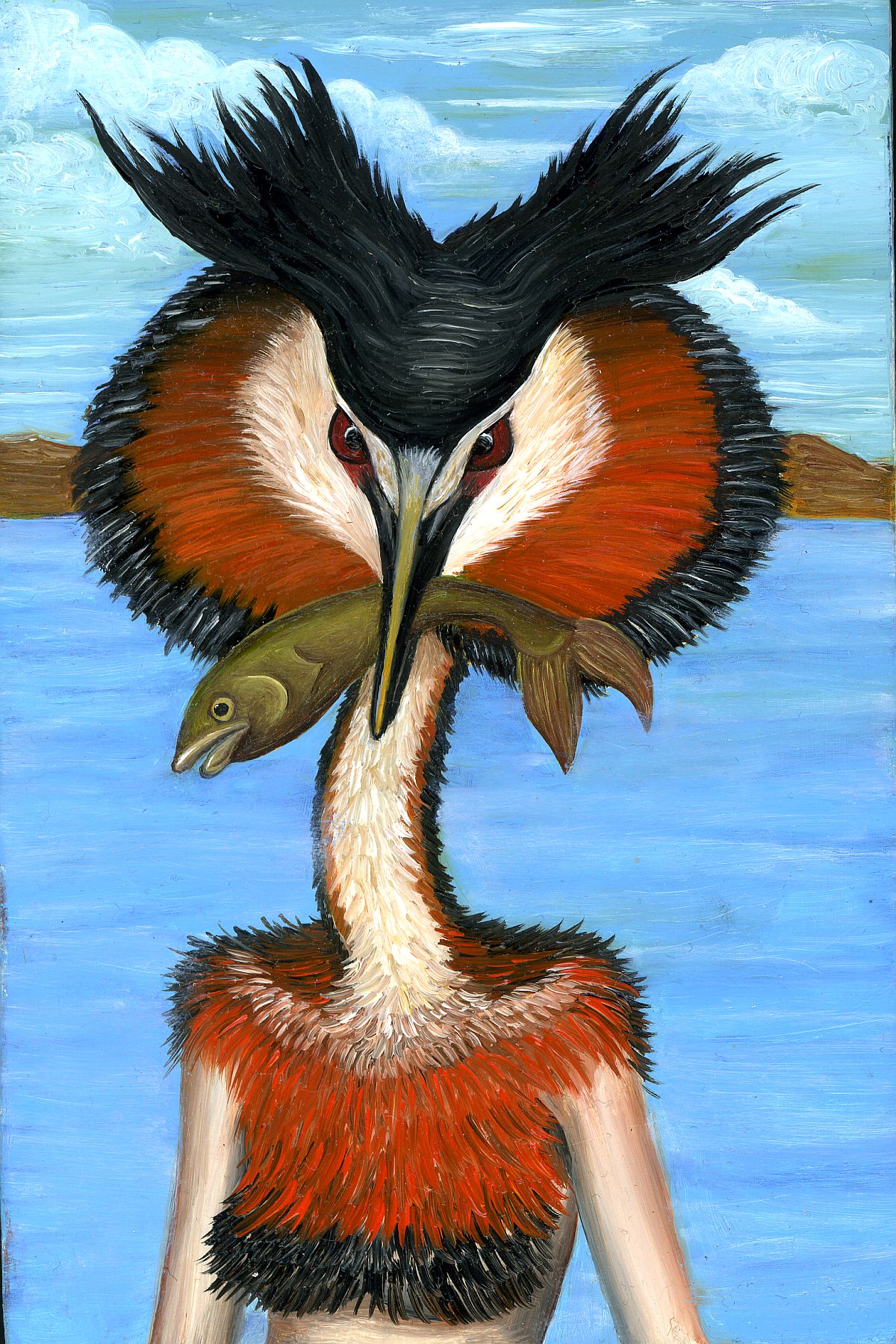
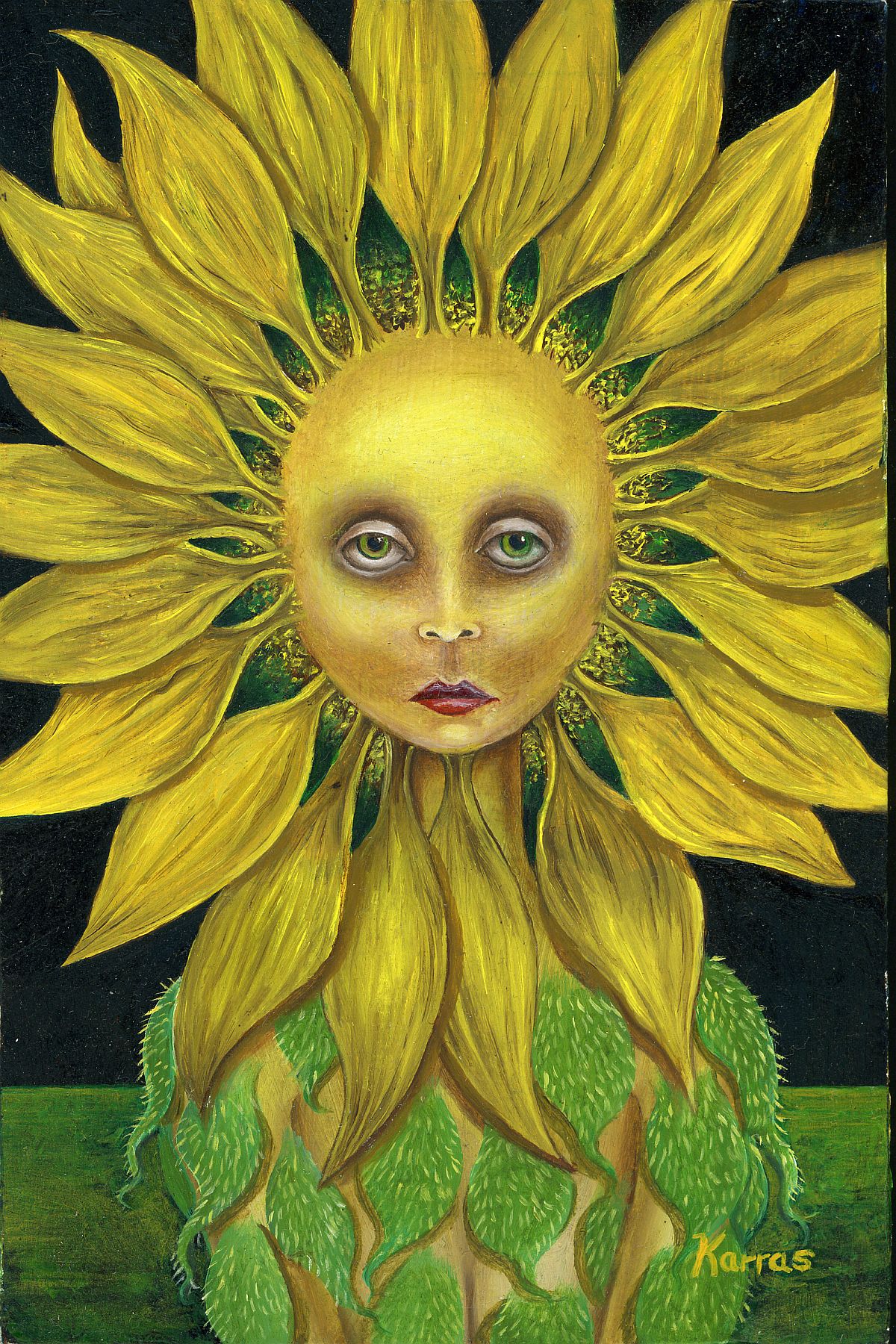
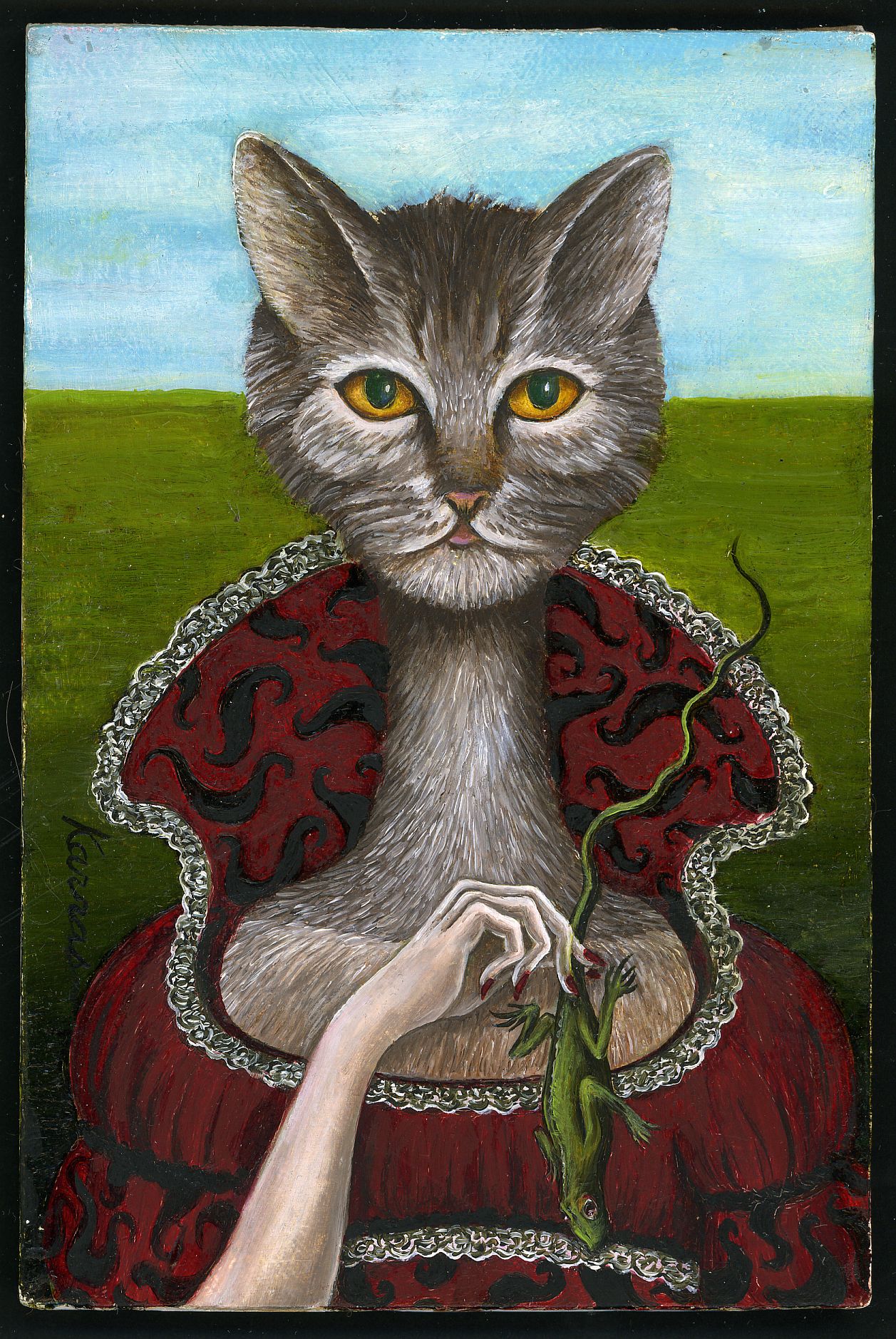
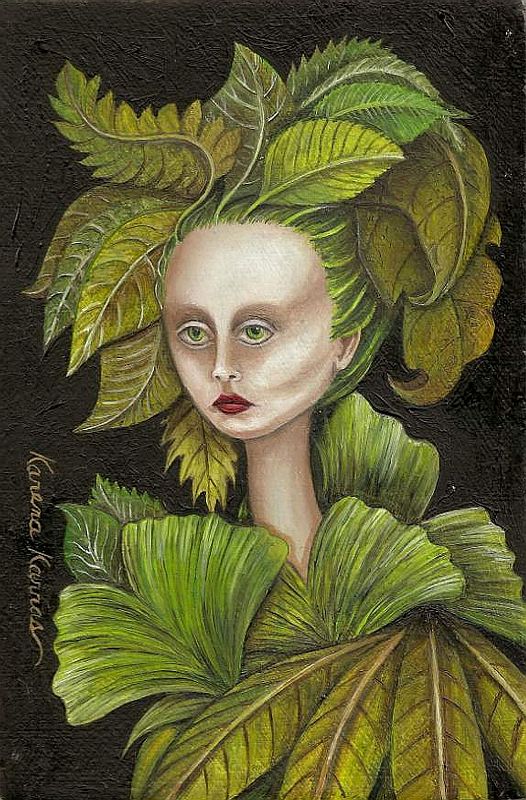
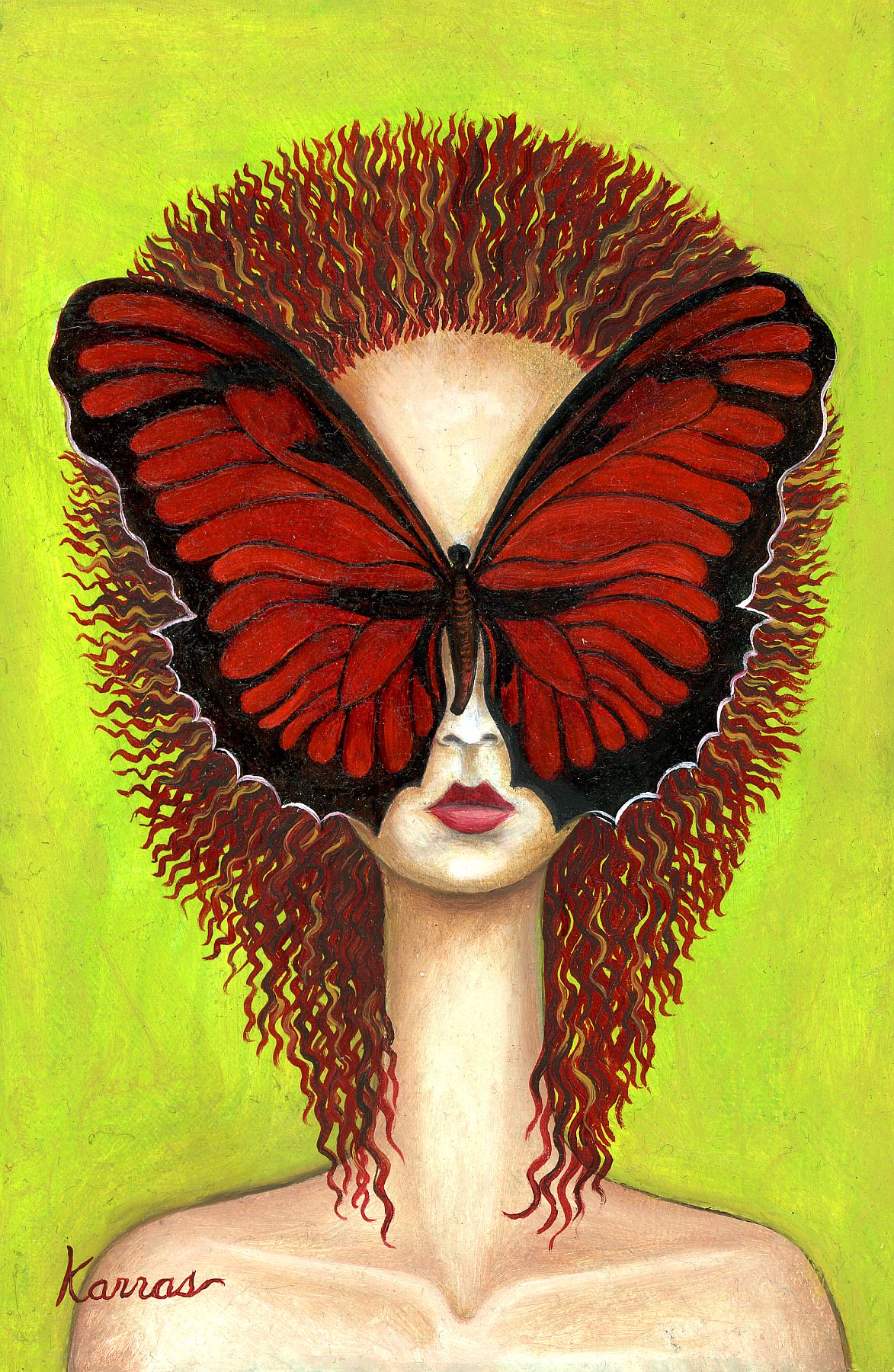
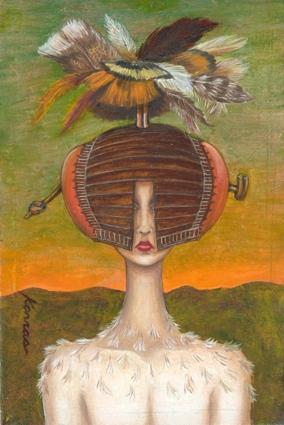
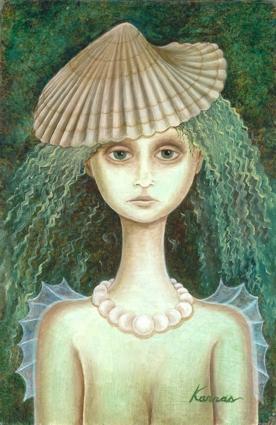
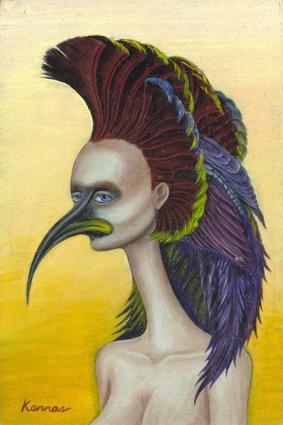
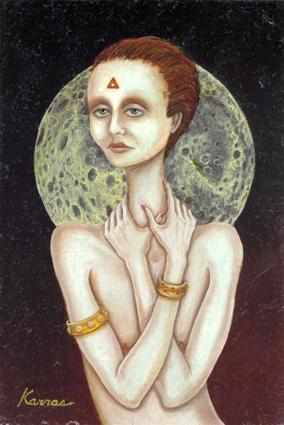
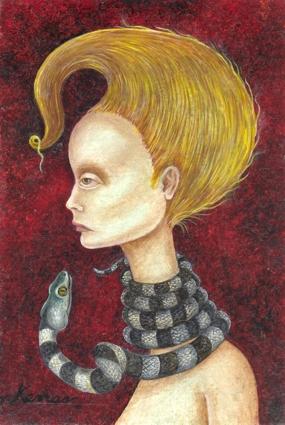
And you thought surrealism was dead. In "Surreal Hybrids," her weird and wonderful new show Chicago painter Karena A. Karras proves that the grand if slightly nutty tradition of Max Ernst and Salvador Dali has life in it yet.
Karras is part of a direct line that goes back to the movement's founding in the early 20th century, connecting with Ernst and Dali by way of two female Europeans who learned from their brethren and went on to find their own voices in Mexico: Remedios Varo, originally from Spain, and Leonora Carrington, the British expatriate who lived with Ernst and with whom Karras formed a friendship when Carrington lived in Oak Park.
You see a lot -- occasionally too much -- of Varo and Carrington in Karras' work, but she's no pale imitation. Quite the opposite: She takes the best qualities of her predecessors' work (especially its ironic echoes of the Italian Renaissance) and intensifies them, then layers on her particular melange of psychology and mythology. In the process, she performs a virtuoso and oddly precise balance-beam act directly on the line between fantasy and reality. It's terrific, playful and seriously beautiful stuff, with a bubbling vitality all its own.
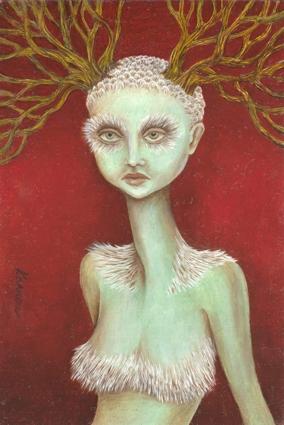
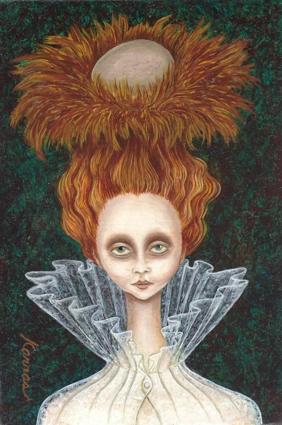
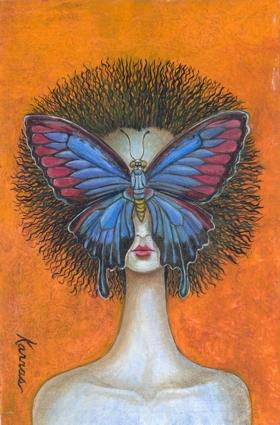
As her title suggests, Karras fixates on the theme of metamorphosis, manifested here in the repeated morphing of the human figure (and specifically the human female) into states both animal and vegetable. A triptych, "Flora, Fauna, Flora," spells this out with a series of portraits of vampire-pale women with Modigliani throats, their scalps sprouting flowers or ferns, their chests adorned with garlands of petals, seed pods and insects.
Ovid and the Greeks, accordingly, would have recognized these ghostly heroines, but they might have been puzzled by the sense that, unlike Daphne and other maidens cruelly transformed by lecherous or capricious gods, Karras' women are far from victims. The alchemy that enchants them, that turns their feet into tree roots and their hair into lush foliage or bird's nests or wisps of smoke, is of their own making. If gender politics were allegorized here, it would be of the expressly woman-empowered variety. (A possible exception is "The Bath," in which a winged creature who might be the offspring of Leda and the Swan appears to be in the midst of being boiled alive, but maybe not. You get the feeling that she likes it hot.)
But I doubt that the artist is thinking along those lines. She has bigger, deeper, stranger things on her mind, or, rather, in its swampy depths -- things that slither and squirm beneath the level of consciousness, making lovely, ominous ripples on its surface.
The question isn't what these ripples reveal as much as what they hide. While at first glance the paintings seem crammed with narrative, for example, the stories they tell are tantalizingly partial, as if arrested in mid-chapter. Theirs is the macabre logic of dreams: perplexing yet not quite nonsense, bizarre and vaguely troubling yet also unaccountably familiar and even mordantly funny. (If you can't smile at "Insomnia," with its cackling crone sporting a fruit-tree coiffure and flushing a covey of ghost moths from her late-night reading, you need to consult your old copy of the Brothers Grimm, who knew how to tell a joke both before and after the wolf eats Granny.)
You can strain to construct a neat box to contain this profusion of metaphysical symbols and Jungian archetypes -- eggs, for example, which are as plentiful here as they are in a hen house -- but the exercise is both frustrating and, probably, counterproductive; to impose narrative coherence on this body of work is to miss its point. What matters is not what sense it makes but the thoughts and feelings it conjures (yes, conjures) in the viewer: fear or acceptance of the body's impermanence, of its molecular connection with nature, and of its intertwined beauty and horror.
All this is rendered with superior craftsmanship, including perfectly spaced composition, assured draftsmanship and luscious Old Master oil brushwork, all of it gleaming beneath layered glazes of the sort we associate with Rembrandt and Vermeer.
There is, not unexpectedly, a polarizing quality about Karras' work. You either really get it or you really don't. If you tend to remember and treasure your dreams, and perhaps even write them down, you'll probably find yourself attracted to "Surreal Hybrids." If not, you may find some new characters on the stage of your nightly dream-theater. Just don't try to touch their hair.
|
|
|
|
Top 10 events of 2005.
Toulouse-Lautrec tops year in art, architecture
Chicago Sun Times
December 18, 2005
BY KEVIN NANCE Art and Architecture Critic
It was a memorable year, 2005, at least for lovers of art and architecture in Chicago. It was the year of Henri de Toulouse-Lautrec and Dan Flavin, of Ludwig Mies van der Rohe and Santiago Calatrava. It was the year of Chicago artists Frank Connet, Karena Karras and Audrey Niffenegger. And it was the year of Petah Coyne, a New Yorker whose spectacular retrospective at the Chicago Cultural Center was one of the most majestic highlights of a grand season. Here, therefore, are my top 10 art and architecture events of the year.
1. "Toulouse-Lautrec and Montmartre" at the Art Institute of Chicago: The year's biggest and best-attended art exhibit, the Art Institute's brilliant show revealed the tragic insight of the great French artist when it opened in July. Best-known for his entertainingly naughty posters of the Moulin Rouge, Lautrec emerged here as a humane and soulful artist whose searing double vision of late 19th-century Paris as heaven and hell was brought into sharp focus.
2. "Above and Beneath the Skin" by Petah Coyne at the Chicago Cultural Center: The year's most electrifying one-person show, this distillation of the best of the artist's work over the past two decades haunts this viewer still. Seductive and sinister, Coyne's almost chokingly atmospheric sculpture and installations seemed, as I wrote in May, "to have staggered up out of a primordial swamp of Western and Asian folk tales, Catholic mysticism, Freudian psychology and the Gothic imagination of Poe and Mary Shelley."
3. Santiago Calatrava's Fordham Spire: It might seem strange to include this project, since it remains uncertain that the Spanish "starchitect's" design for a hotel-condo tower, which would be the tallest building in the U.S., will ever get built. But there's no denying that, when it was announced in July, the project's exquisitely tapering spiral design caught the public's imagination. Even if it only ever exists on paper, the Spire is drop-dead gorgeous.
4. Audrey Niffenegger's The Three Incestuous Sisters: Some of the year's best art since it was available since August in bookstores in the form of this masterpiece of a novel-in-pictures by Columbia College's resident genius. Fourteen years in the making, The Three Incestuous Sisters tells a crackling good melodrama about love, jealousy and loss -- mostly by means of a series of breathtakingly beautiful aquatint prints that incorporate influences as diverse as Francisco Goya, Edward Gorey, film noir and Japanese manga.
5. Renovation of Ludwig Mies van der Rohe's S.R. Crown Hall at the Illinois Institute of Technology: Mies' renowned temple of architecture on the IIT campus had been looking rough at the edges, but this year's renovation, overseen by Chicago architect Mark Sexton and unveiled in August, has it looking spiffier than ever, its glass replaced and its grayed-out steel I-beams repainted a robust black. "In an unexpected way," I wrote, "this newly pumped-up muscularity of color reveals, punctuates, supports and complements the glass more powerfully than before, making the building's south face seem even more transparent and floating."
6. Karena Karras in "Surreal Hybrids" at the Gruen Galleries: In her small, shockingly good and sadly short-lived September show, this Chicago artist proved that there's life left in the Surrealist tradition. A bold visual essay on metaphysical transformation, it conjures what I called "fear or acceptance of the body's impermanence, of its molecular connection with nature, and of its intertwined beauty and horror."
7. The re-unveiling of Cloud Gate in Millennium Park: Another unfinished project, Anish Kapoor's giant sculpture -- reopened to the public this fall with more still to be done to buff out the seams of its mirrored stainless-steel surface -- has nonetheless emerged as perhaps Chicago's favorite public artwork. Its reflective, image-warping quality, which bends viewers and neighboring buildings to its figurative will, has proved irresistible.
8. Frank Connet textiles at the Douglas Dawson Gallery in September: This talented Chicago artist combines his expert knowledge of antique textiles to create startlingly contemporary and vibrantly colorful compositions influenced by ethnographic imagery and Abstract Expressionism.
9. Visionary Chicago Architecture: This volume of architectural concepts for seven "gateway" locations in Chicago, guided by Stanley Tigerman and issued in May, is full of delightfully imaginative ideas by some of the city's best young and established architects, including John Ronan, Jeanne Gang, Helmut Jahn, Dirk Lohan, Carol Ross Barney, Doug Garofalo and Adrian Smith. The concepts aren't always practical, but they sure are thought-provoking.
10. "Dan Flavin: A Retrospective" at the Museum of Contemporary Art: This late artist, a Minimalist icon whose medium was fluorescent light in various colors, isn't everyone's cup of chai -- in part because he was, in life, so cantankerous. But you could see, in the MCA's lovingly installed summer show, a fugitive spirituality -- a radiance that connects, whether he intended it or not, to the infinite.
http://www.suntimes.com/output/galleries/sho-sunday-art18.html
http://www.suntimes.com/output/galleries/sho-sunday-art18.html
|
|
|
|
Devils and Beasts
2007
The Art Center Highland Park
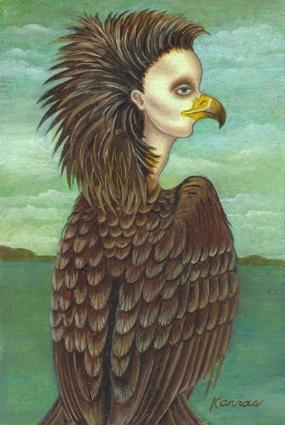
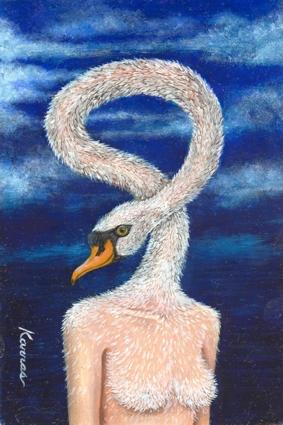
The 'beasts' of Devils and Beasts are most often half-human, half-kindled into animal. Both folktales and fairy tales reference such halfway transformations, which may be alternately commentary, penance, or release. Karena A. Karras's work in oil tends toward expressions of mystical, symbolic content. In The Bath (oil on board) Karras depicts a swan-woman, rampant in a tall chimney-like vessel which is actually an alchemical bath. Her long, curving neck and pale torso reflect an aching desire for beauty; but which way, into which creature, woman or bird, is the transformation occurring? A white dog and a full moon add to the impression of mystery and metamorphosis. The dour bird-faced woman of a nearby painting, Ezgadi (oil on board), also by Karras, suggests the unhappy result of such transformation.
Katherine R. Lieber
Katherine R. Lieber has edited ArtScope.net's Visual Arts reviews since 1998. Ms. Lieber is Editor and Associate Producer for ArtScope.net.
|
|